Ferrocement Panels are considered "Green Material"
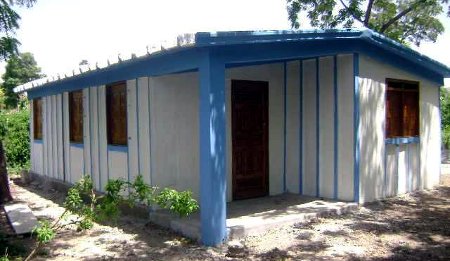
Cement and Concrete have a bad reputation for being high pollutants. But that is all very relative! Analyzing the real life situation in walls, it turns out that certain use of concrete is among the most sustainable alternatives available in most places around the globe. While the production of cement does consume much energy, if used intelligently, the resulting walling elements have a low count of embodied energy and its life cycle compares well with any material.
Over the last three decades many scientists have been working on defining the "ecological rucksack" of different materials. This includes the count of all energy that goes into a product, from mining through production, transports and making a wall. But ideally one also looks at maintenance over a given time span and the energy used to dismantle it at the end as well as whether it can be reused or not, this is called the "life cycle analysis" and tells you how sustainable the material or technology is.
A team the Technical University of Zurich (ETH Zürich) has published an interesting study1 where they come to the conclusion that it is the very local solutions like bamboo and the very top ones with concrete that can be most sustainable:
The case of concrete is very special, as many authors regard it as one of the most energy-demanding, carbon emission intensive and waste-producing construction materials; at the same time, its versatility is difficult to match. Beyond its well-known durability and mechanical strength, concrete can be easily mixed with other construction materials, it can be produced either at large industrial scales or at the local handcrafted level, and there is a long tradition of concrete construction education and research.
These results show that there is a promising future for concrete in the sustainable affordable housing sector.
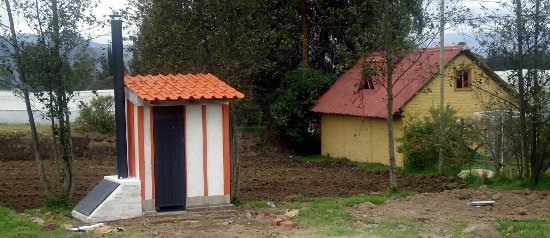
FerroCement walling system in a Dry Toilet in Ecuador, South America
While the massive use of bamboo in housing has obvious regional and social limits, concrete is already everywhere and most people want it. The study screened 75 different technologies and what is among the most promising are light weight concrete panels. EcoSur made an assessment of the Ferrocement panels promoted by some of our members and it is evident they are in the top group.
Franklin Martinez and Kurt Rhyner did an in-depth analysis of the raw materials used for the most prominent walling systems in Latin America
| Walling system | Cement kg |
Sand litres |
Steel rods kg |
Soil litres |
Energy |
| Hollow blocks, 15 cm wide, with structure of reinforced concrete | 47.98 | 215.63 | 8.83 | 0.00 | ??? |
| Soil-cement blocks with structure of reinforced concrete | 52.08 | 144.51 | 8.83 | 224.55 | ??? |
| Handmade solid clay bricks with structer of reinforced concrete | 40.13 | 146.34 | 8.83 | 195.52 | ??? |
| FerroCement wall panels, including wire mesh | 37.46 | 111.20 | 7.10 | 0.00 | 4.2 MJ |
Technical sheet available for download (in english)
In this table it becomes obvious, that the ferrocement panels are the "greenest" of those technologies, when they are compared under similar conditions, mainly resistance to earthquakes, hurricanes and inundations.

In October 2012 we reported that UN-Habitat has included ferrocement panels in the book "Going green" and as founding members of the program "Global Network for Sustainable Housing" we are providing input into the knowledge base they are building on this theme.
The EcoSur network has been working on the issue of "incorporated energy" and "life cycle analysis" since its beginning around1990 and we have always looked at the different technologies and materials under those conditions, a PhD thesis on the sustainability of roofs and two professoral exchanges between Latin America and Europe from those days provided the base.
The extensive work done in substitution of cement, under the leadership of CIDEM and the establishment of lime-pozzolana production in several countries gave way to a high-tech investigation on producing a different type of cement which is now the main theme of the cooperation between CIDEM and the technical University of Lausanne. This project has now gone into the practical stage with trial production in Cuba and India and we expect soon to be able to report on real life results.
Recently the first results of using biological additives to concrete have been reported here.

Locally-produced FerroCement walls have reduced emboided energy - Haiti
1) Wallbaum, Holger, et al. "Indicator based sustainability assessment tool for affordable housing construction technologies." Ecological Indicators 18 (2012): 353-364.


