News
EcoMaterials in the World Urban Forum

As a partner of the Agenda Habitat, EcoSur will show at the World Urban Forum its experience in social housing programs who are looking for durable, economical and formal solutions. Specialists from Nicaragua and Switzerland will present technologies with cement based concrete, minimizing its consumption and maximizing quality in the final product, it is, the house.
The World Urban Forum (WUF) is a non-legislative technical forum convened by the United Nations Human Settlements Programme (UN-Habitat), hosted in a different city every two years, to examine the most pressing issues facing the world today in the area of human settlements, including rapid urbanization and its impact on cities, communities, economies, climate change and policies. It is the World’s Premier Conference on Cities.
Ferrocement panels gain acceptance
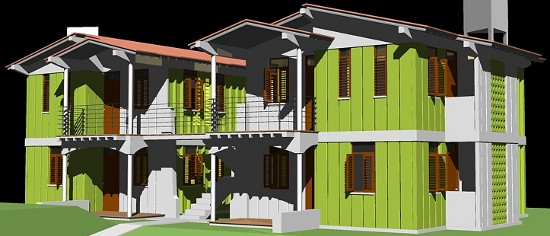
A new UN habitat publication highlights the Cuban experience of building with ferrocement panels, while a series of apartment houses are under construction with this technology in the Dominican Republic, as well as two community buildings in Haiti.
The “International Ferrocement Society » (IFS) organizes its 10th International Symposium on “Ferrocement and Thin Reinforced Cement Composites” (www.ferro10.com) in Havana, Cuba, in the month of October.
Ferrocement panels gain acceptance
A new UN habitat publication highlights the Cuban experience of building with ferrocement panels, while a series of apartment houses are under construction with this technology in the Dominican Republic, as well as two community buildings in Haiti.
The "International Ferrocement Society » (IFS) organizes its 10th International Symposium on "Ferrocement and Thin Reinforced Cement Composites" (www.ferro10.com) in Havana, Cuba, in the month of October.
Pedro Galiano, a senior Cuban Architect proudly presents the first of a series of two-storey houses in the Dominican town of San Francisco de Macoris. Galiano is a pioneer of this construction technology and former president of the Cuban Union of Architects and Engineers (Union de Arquitectos e Ingenieros de Cuba, UNAIC), and since his retirement he has been consulting the Municipality of San Francisco. Among his many projects is the installation of a production facility for ferrocement panels and the construction of some buildings. Now he has started a small colony of social housing with a local developper. At the same time he is also a consultant to the programs of Sofonias Haiti* and he will supervise the installation of the second level panels in the community centers built for UNDP.
The Haitian partner of the EcoSur Network has been building shelters with the panels since the earthquake and with support from UNDP they are starting the construction of two community centers in destroyed areas in Port au Prince. This type of construction can be locally prefabricated and then assembled within a very short time, a great advantage when rebuilding in densily populated areas. The project is teaching a group of 30 people, mostly women, to produce and build with this technology.
From October 12th to 17th, the Cuban branch of the International Ferrocement Association, headed by Dr. Hugo Wainshtok, organizes its 10th World Summit in the Palacio de Convenciones in Havana where interesting presentations are schduled. There will be much debate about the use of different fibres and meshes, to modernize the old technology towards more sophisticated industrial processes, but also reports on more humble and simple applications like the three presented here.
Dry sanitation is absolutely the solution
 Post graduate students of the University of Freiburg (Germany) have conducted a study on different toilet systems in Namibia. They concentrated on existing solutions in this arid country, interviewed users, technicians of different Ministries and local authorities. Their conclusions are clear:
"Dry sanitation systems are very appropriate to give more Namibian people access to improved sanitation. This project study has shown that especially the Otji-toilet works quite well... although most interviewed people preferred a flush toilet, the financial capacities of the people and the natural conditions of Namibia with limited water sources do not allow an implementation of wet sanitation systems on a large scale"
Haiti reconstruction with ferrocement impresses UNDP

High ranking visitors to a newly started production unit in Port-au-Prince (Haiti) congratulated the manager of the local EcoSur partner for an impressive start into a new project which aims to form micro-enterprises to produce construction materials for the country's reconstruction. Helen Clark, the former Prime Minister of New Zealand and actual administrator of the United Nations Development Program (UNDP) expressed her satisfaction at the high quality of walling and roofing elements produced by the women and men of the workshop in a neighborhood badly damaged by the 2010 earthquake.
Read more: Haiti reconstruction with ferrocement impresses UNDP
How to build an Urine Diverting Dry Toilet, UDDT
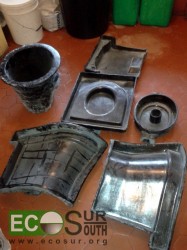 At the beginning, the toilet bowl used by the Dry Toilet was very simple, without the water trap. The solids and liquids felt directly to the drying buckets under the surface. In 2010, a Urine Diverting Toilet Bowl was built and this new toilet bowl transformed the Dry Toilet in an UDDT: Urine Diverting Dry Toilet.
Estuardo Quispillo, technician and instructor from EcoSur Ecuador went to Haiti to train the staff in UDDTs building using a very practical fiber glass mould.
Haiti: Two years after the earthquake

Much has been written about the slow pace of reconstruction in Haiti. While those reports are largely true, there are also positive developments. The EcoSur partner Sofonias Haiti is reporting encouraging facts and looks with hope into the future.
Ferrocement panel houses evaluated in two Universities

The INTEC (Instituto Tecnológico de Santo Domingo) and the CUJAE (Polytechnical University of Havanna) have recently published two Diploma thesis on buildings with ferrocement panels like the ones used by grupo sofonias in the reconstruction of Haiti. Both came to similar conclusions and recommend the technology because of its high resistance to earthquakes and hurricanes and the savings in materials, energy, time and finances
Read more: Ferrocement panel houses evaluated in two Universities
Ferrocement panel houses evaluated in two Universities
The INTEC (Instituto Tecnológico de Santo Domingo) and the CUJAE (Polytechnical University of Havanna) have recently published two Diploma thesis on buildings with ferrocement panels like the ones used by grupo sofonias in the reconstruction of Haiti. Both came to similar conclusions and recommend the technology because of its high resistance to earthquakes and hurricanes and the savings in materials, energy, time and finances
Read more: Ferrocement panel houses evaluated in two Universities
Dry Toilets in Latin America
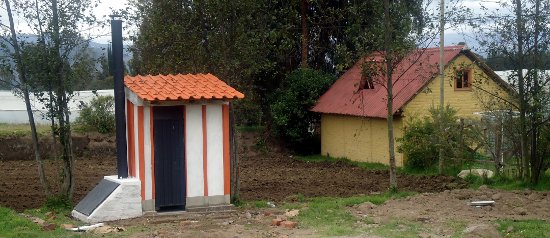
In the rural and semi-urban communities, that are the main target of the housing projects from the EcoSur network, sewer systems are non-existent and sewage disposal becomes a problem, sanitary and economic. The Dry Toilet, developed in Namibia by the Clay House Project*, has become an adequate and inexpensive solution for countryside communities and outskirts.
United Nations recommend the Dry Toilet "Otji"

Catarina de Albuquerque, special rapporteur from the "Office of the High Commissioner for Human Rights" visited Namibia in July 2011. The objective of this visit was to assess the manner in which Namibia is realizing the human rights to water and sanitation.
Ms. Albuquerque visited, among other places, the Clay House Project* and we would like to cite from her press release.